

[T]he study of mobility and transport reveals existing power relations and offers opportunities to challenge those relations.
Julie Cidell, José Acosta-Córdova, Andrea Pimentel Rivera & Ricardo Zapata, “Critical geographies of transport and mobility”, 2021, p. 2
Transport geographies has a long history that predated the arrival of traditional conveyances and modern-day vehicles. The mobilities community (Schwanen, 2015), neoliberal and post-neoliberal forms of capitalism, and the decolonisation of expert knowledge in transport geographies have been explored in the last few decades in the public sector, academe, and activist circles. More often the economic and social contexts are investigated and weighed in to evaluate the efficacy of transport models and frameworks aimed at benefiting the population but also to promote businesses.
Two maps created and developed by cartography students in the UP Diliman Department of Geography’s Digital Cartography class (Geography 197) hope to provide stories in a subaltern setting to tell what’s on the ground and enhance the obvious (inequality in this case) and at the same time offer an open-ended question to challenge society to action.
Who owns the community traversed by its population? What micro-routes are plied by affordable transport vehicles that navigate urban and rural setting? Who determines the price of fare?
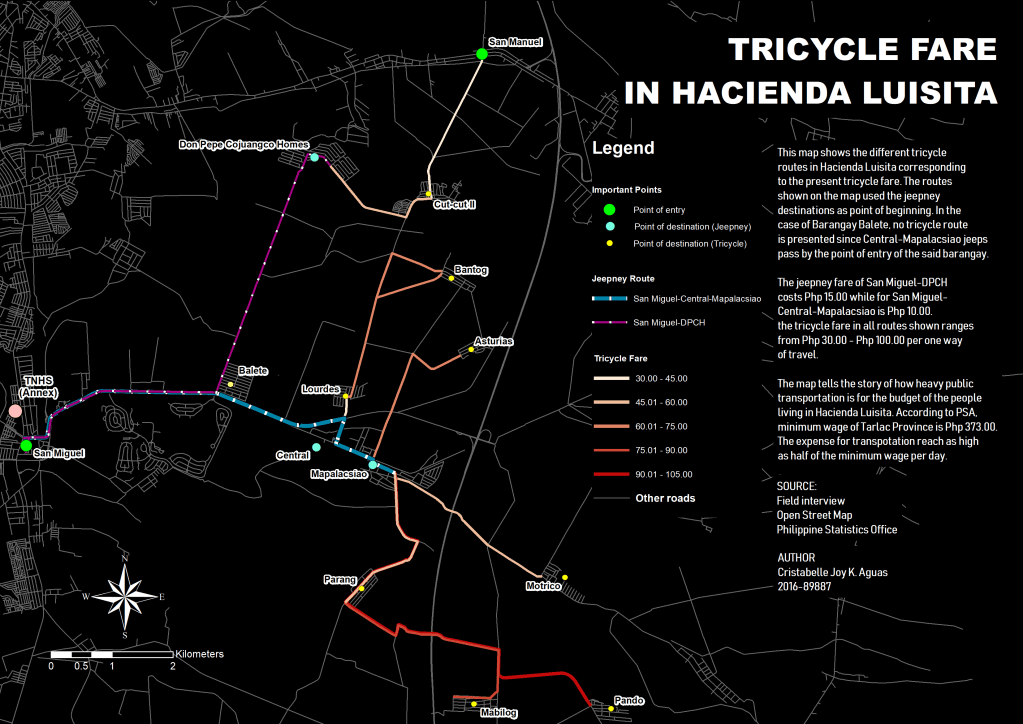
Map 1: How expensive is transportation in Hacienda Luisita, CJ Aguas, 2018 (submitted for the Geog 197 class under Prof Ony Martinez).
In Cristabelle Joy Aguas’ map entitled How expensive is transportation in Hacienda Luisita (2018), the map was intended to give people a
backgrounder through a field-generated representation how expensive public transportation is in Hacienda Luisita. A resident of the area, Aguas provides a pre-pandemic situationer that relates to her experiences and personal issues within the community she grew up in. The data were gathered from field interviews in Hacienda Luisita (see Map 1).
According to Tarlac City Public Order and Safety Office (POSO), the TODAs (Tricycle Owners and Drivers Association) in Hacienda Luisita are not regulated by the Land Transportation Franchising and Regulatory Board (LTFRB). The TODAs have their own respective tricycle fares. The tricycle fare ranges from Php 30.00 – Php 100.00 per travel. According to PSA, the minimum wage per day in Tarlac Province is Php 373.00. It can be inferred that the portion of transportation expenses may reach as high as half a daily minimum wage. Because of the expensive costs of public transportation in Hacienda Luisita, some residents opt to take alternative modes such as biking, acquiring a pre- owned vehicle/s (particularly motorcycles and tricycles), and walking, regardless how far the destination is. Affordable transportation is not affordable anymore.
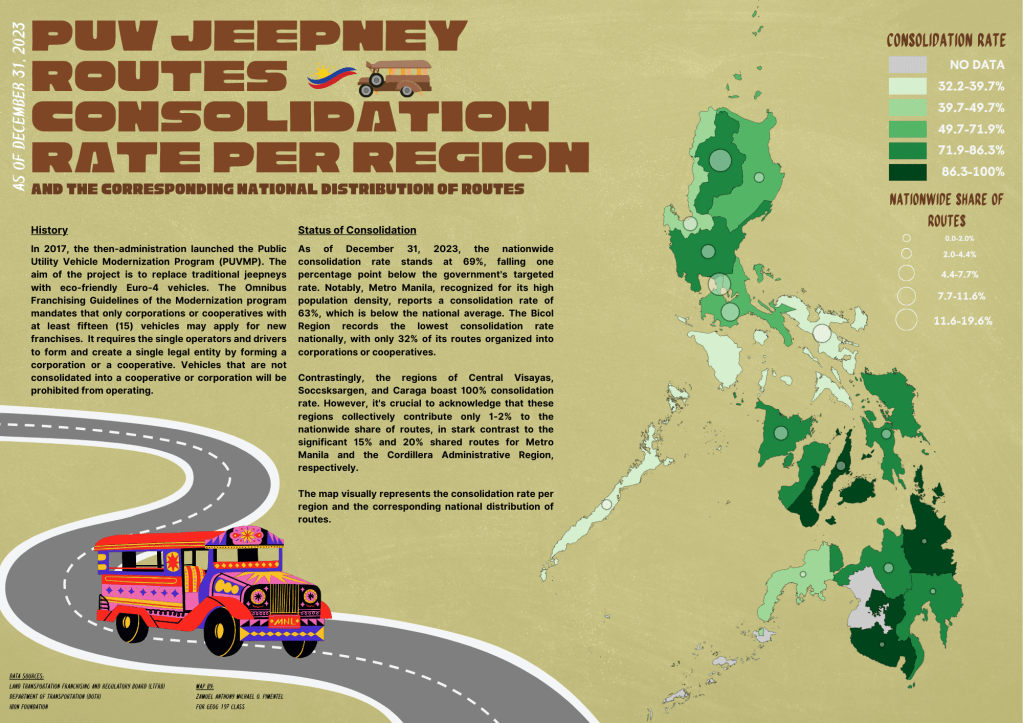
Map 2: PUV Jeepney Routes Consolidation Rate Per Region, ZAM Pimentel, 2023 (submitted in Geog 197 under Prof Ony Martinez).
The controversial directive issued by the LTFRB in 2023 (Memorandum Circular 2023-051) mandates that:
In all routes WITHOUT CONSOLIDATED [Transport Service Entities], all Provisional Authorities (PA) issued to INDIVIDUAL OPERATORS are DEEMED REVOKED effective 01 January 2024, and the units authorized therein shall not be confirmed for purposes of registration as public utility vehicles.
The consolidation — which can cost upwards to Php 2million — was decried by jeepney operators and transport groups as punitive to small-scale operators who make their daily living tranversing various road ecologies on a daily basis. The memorandum circular has been given extensions (Jan 31, 2024 & April 30, 2024) but the spectre of these commuter vehicles utilised by the working class majority nationwide which would soon give way to ‘environment friendly’ modern vehicles, offer a glimpse of Philippine roads devoid of the colorful jeepneys that have become mainstays in post-World war II Philippines (Luna 1978).
Zam Pimentel who created a map (see Map 2) entitled PUV Jeepney Routes Consolidation Rate Per Region, offers this overview:
In 2017, the then [Duterte] administration launched the Public Utility Vehicle Modernization Program (PUVMP). The aim of the project was to replace traditional jeepneys with eco-friendly Euro-4 vehicles. The Omnibus Franchising Guidelines of the Modernization program mandates that only corporations or cooperatives with at least fifteen (15) vehicles may apply for new franchises. It requires the single operators and drivers to form and create a single legal entity by forming a corporation or a cooperative. Under the mandatory franchise consolidation, only one cooperative or corporation will receive a franchise to operate on a specific route. Traditional jeepneys that are not consolidated into a cooperative or corporation will be prohibited from operating. The map visually represents the consolidation rate per region and the corresponding national distribution of routes.
The forced privatization of public transportation poses a significant threat to
traditional jeepney drivers’ jobs and raises concerns for the general public. There is apprehension that this shift may result in a substantial increase in jeepney fares, potentially reaching percentage point below the government’s targeted rate.
The two highly visual maps tell stories culled from data gathered from interviews and secondary sources, but they also inform the situations that show spatial inequality and injustice where commuters and jeepney drivers take the shortfall from the legacies of neoliberal and post neoliberal capitalism.
These outputs from Geography 197 under the leadership of Prof Martinez shows responsible geovisalization where field-based data ostensibly speak of factual information of a population but the same visualization also shows how people end up getting the short end of the straw.
JS Palis, CJ Aguas, ZAM Pimentel, MS Martinez
February 15, 2024
References
Julie Cidell, José Acosta-Córdova, Andrea Pimentel Rivera, Ricardo Zapata (2021). Critical geographies of transport and mobility: Studying power relations through practice, academia, and activism, Geography Compass, 15:12, 1-14.
Telesforo W Luna, Jr (1978). The Jeepney: a low cost transportation in metropolitan Manila (monograph), Pamantasan ng Lungsod ng Maynila.
Catalina Ricci S Madarang (2023). Why jeepney phase-out concerns teachers amid weeklong strike, Interaksyon, March 6, 2023.
James Relativo (2023). Transport strike ‘until New Year’ set vs 2024 prohibition on unconsolidated jeepneys, Philippine Star, December 15, 2013.
Tim Schwanen (2015). Geographies of transport I: Reinventing a field?, Progress in Human Geography, 40:1, 126-137.
 Geonarratives PH
Leave a comment