Memories of place can produce different social ramifications for different people. On one hand, nostalgia can play a significant role in reminiscences that can romanticise places (see also what media scholar John Fiske said about indulging in nostalgia); on the other hand, there is a propensity for ‘appropriating places’ through the visual recollection of places (Korkiakangas 2004). Psychology professor Igor Knez maintains that ‘autobiographical’ memory of physical places plays a huge part in what he terms as the “perceptual, semantic, and emotional characters of periods” of individuals’ lives (2006, 359). Still, is it possible to forget in the act of remembering places (Hoelscher & Alderman 2004)?
In an online pedagogical repository (The Memoirs of UPLB Students) that curates stories of place among students of the University of the Philippines-Los Baños, and conceptualised, developed and managed by Assistant Professor Ryan Alvin Pawilen, the narrative-cartography site are story maps showcasing the diverse stories and experiences of selected UPLB students related to different locations within the UPLB campus. This project drew from ideas to create or do something new emanating from aProf Pawilen’s doctoral cognate courses in geography in UP Diliman, and the story maps, like the ‘Layers of London’ by the Institute of Historical Research at the University of London. These projects showcase the intersections of technology, creative mapping, and public history to preserve local history, heritage, and sense of place. The title of the site draws inspiration from José Rizal’s Memoirs of a Student in Manila (translated), as the first participants were students in aProf Pawilen’s PI 10 course (Rizal course for UPLB). Click this link to view the storymaps of places in UPLB; or click this link instead: https://arcg.is/1nKrbu0
Beyond presenting the relationship between geography and history, these story maps allow participants and readers to rethink the idea and sense of place through shared or unique experiences. They uncover layers of meaning about campus locations beyond their official names or stories. In turn, these personal narratives enrich the history of the campus, offering insights not always captured in official documents or other types of maps. While buildings form the physical aspect of the UPLB campus, what makes it memorable for its students and alumni are the stories created with and within these spaces.
The maps were created using the StoryMap feature of ArcGIS, primarily utilizing its basic functions due to the admitted inexperience of aProf Pawilen. Photographs were either personally taken by him or student assistant Leah Joy Ostria, a BS Forestry student at UPLB. Additionally, a few photos were cited from Google Maps and other sources.
The stories were gathered through a Google Form where students provided specific locations within the UPLB campus and their related personal memories. The map did not mention the students’ names, and they were given the opportunity to review the map and suggest changes, including the withdrawal of their entries from the draft.

Map 1: Freedom Park, UPLB; RAM Pawilen, https://storymaps.arcgis.com/stories/33e475de3ce6496fa3b8aa56471795b6
There were several places in campus that were cited by students that bring vivid and resonant memories. Freedom Park (F Park) attracted a lot of stories from students.
There is an enlargement and intensification of personal feelings that students associate with the place:
“My love for this place really cannot be defined by one situation. I love sitting here at night and watching the stars above me; I find it calming, feeling as if I’m one of them. Sitting here after a long, tiring day of classes provides me the comfort I need. Watching other people going on their busy lives as a mere spectator reminds me that I’m just like them, that the overwhelming feeling I have will also pass. And one time, I got to go there before sunrise, the Christmas decorations were just about to be finished, it felt serene.“
[S]eeing tiny people scattered along the green blanket of Freedom Park allowed me to process how the situation is becoming more real with each second: I am now in college.
The stillness and calmness of the surroundings provide a sense of comfort and solace that is hard to find elsewhere. It is a place where I can momentarily escape the worries and stresses of life and just be present in the moment.
The temporal dimensions as well as mindful perception come together emanating from multiple emotional crevices that assist in the modulation of students’ selective attention. F Park serves as a reminder of a campus space that serves as a respite from the grueling demands of academic and everyday life.

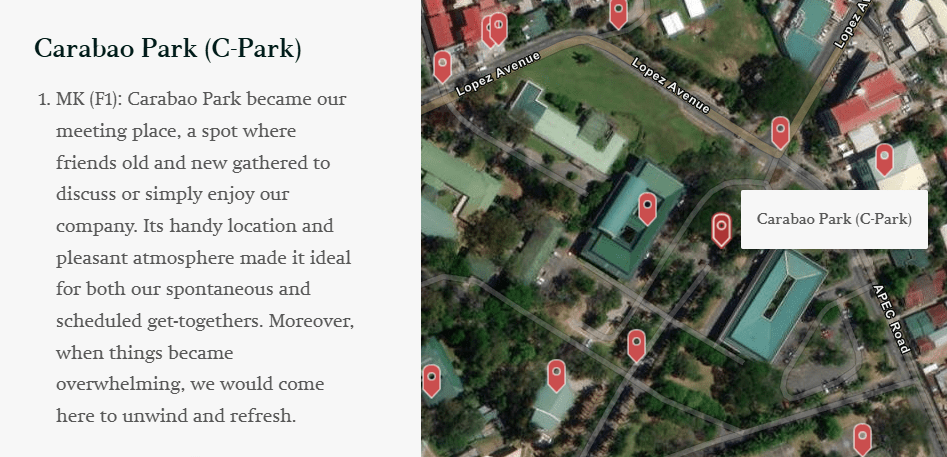
Map 2: Carabao Park, UPLB; RAM Pawilen https://storymaps.arcgis.com/stories/33e475de3ce6496fa3b8aa56471795b6
Carabao Park or C-Park is another campus space frequented by the academic community of UPLB. Emotions range from ecstatic-nostalgic to ambivalence as further proof that the same occupied space can be differently encountered and experienced. Some of the observations of aProf’s Pawilen’s students include the following reflections:
This is where my love/hate relationship with frogs started. While I generally find them disgusting, I can’t help but smile when I see them scuba diving in the CPark pools. This is also where I wait for my friends to get off their examinations and for Elbids meetups to happen.
It is … the place where students rally and fight for what is right and just which made me feel so empowered.
Dito ko unang naranasan sumali ng mobilisasyon. Tanda ko pa rin ang pinaghalong bigat, saya, at halo-halong mga emosyon nung ako ay nandoon, nakatayo, sumisigaw kasama ang kapwa ko magaaral. Grabe ang fulfillment kapag tapos ng mga mob kasi pakiramdam ko ay bahagi ako ng isang bagay na mas malaki kaysa sa aking sarili pero hindi pa rin pakakampante siyempre kasi hindi lang naman doon natatapos. [This is the place where I first joined a student-led mobilization rally. I remembered the combination of strain, exultation and a mix of emotions as I stand there in solidarity with my fellow students. I experienced the exhilarating sense of fulfillment upon the conclusion of the mob as I feel I am part of something bigger than myself even if I know the struggle continues.]
I love hanging out with the community animals that the organization of UPLB (Cats of UPLB) takes care of.
Unlike the mostly positive perception by students of Freedom Park because of the combination of human and non-human elements, Carabao Park becomes a reflective place that serve as individual meet-ups, as space to be mindful of animals, and as a space for emancipatory activism and advocacies.
Culled from different classes in Philippine history and institutions, aProf Pawilen hopes to continue the project to encourage faculty and students to explore the numerous applications of story maps and creative mapping for research, pedagogy and community service.
Browse The Memoirs of UPLB Students site to read more place stories of UPLB.
Joseph Palis & Ryan Alvin Pawilen
Acknowledgments
Students of HIST 1 / KAS 1 and PI 10 under Asst Professor Ryan Alvin Pawilen.
References
John Fiske (2010). Understanding Popular Culture, 2nd edition, London: Routledge.
Steven Hoelscher & Derek H Alderman (2004). Memory and place: geographies of a critical relationship, Social & Cultural Geography, 5(3), pp. 347-355.
Pirjo Korkiakangas (2004), Memories and the Identity of Place: Strategies of Town Residents in Jyväskylä, Memories of My Town: The Identities of Town Dwellers and Their Places in Three Finnish Towns, (A-M Åström, P Korkiakangas & P Olsson, eds.), Helsinki: Finnish Literature Society, pp. 150-171.
Gregorio F Zaide & Sonia M Zaide (1983). José Rizal: Life, Works, and Writings of a Genius, Writer, Scientist, and National Hero, Metro-Manila: National Book Store Publishers.
 Geonarratives PH
Leave a comment