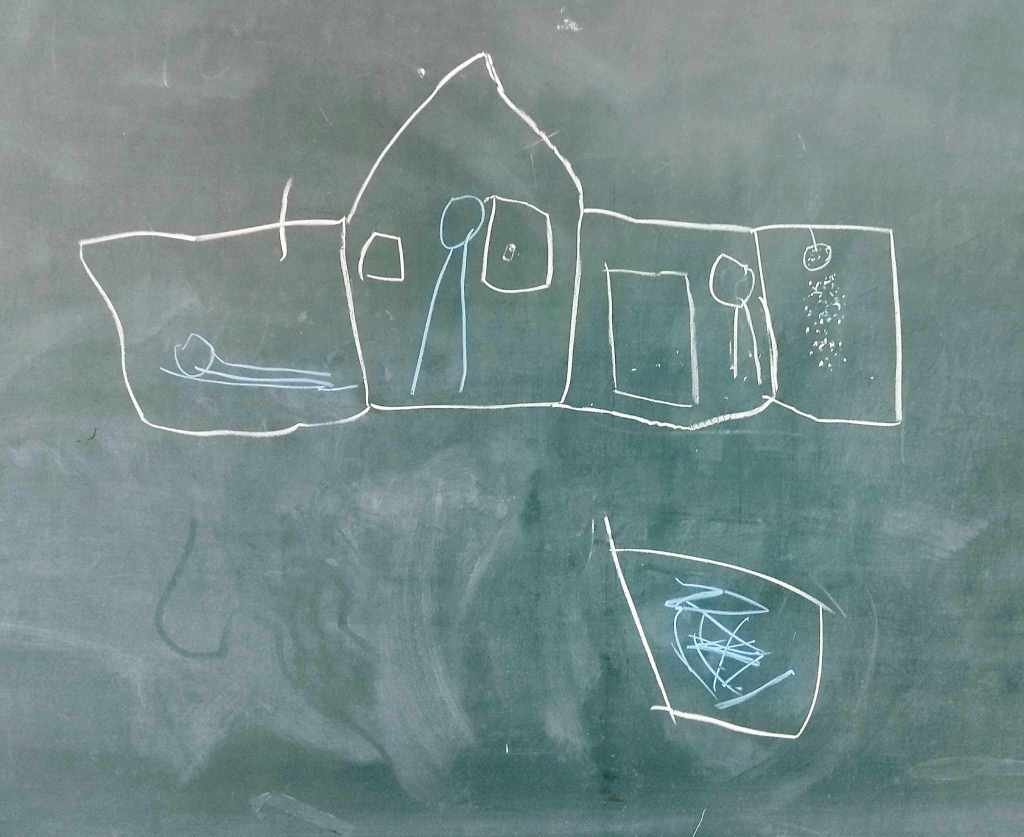
An unidentified drawing of a house in a college classroom, 2025
This page collects various geonarrative mapping stories by students, activists, academic faculty, artists, and various other individuals and collectives around the world. It promotes alternative kinds of mapping that make visible multiple stories of place, identity, situation, ideology, perfomativity, and pinning what can be pinned from the elusiveness of non-representation.
We are often confronted with the idea of maps as graphical representations of the earth, and by extension landscape, territory and the spatial extents of tangible objects that manifest various forms of materiality. But the spatial turn empowered critical geographers to think of map and territory as constitutive and interwoven having relational and processual linkages and engagements. Making visible geo-referenced points is the goal of conventional cartographers but recent decades showed how resistance to hegemonic order, decoloniality, shifts in knowledge production also consider the slippages, the ruptures and the fissures that conventional maps (mass)produce allow for recognition of erasures and omissions along the cartographic lines of a map. There is a lot of stories that can emerge from these subjugated knowledges that were rendered invisible through time.
Our project is a modest contribution to creating newer avenues for map production by the inclusion of stories. Geonarratives is a way of acknowledging stories that underpin each visual image. According to Joseph Palis (2022), the inclusion of stories in cartographic production is a form of place-writing where “subjective stories that define, portray, delineate, emphasize, expand, rewrite, and imagine a place” (p. 700). The importance of narrative to enrich the 2-dimensionality of a map is how narrative bolsters critical spatial thinking that encourages an enriched engagement with events, locations, behaviors, and situations and a mindfulness of one’s place in the midst of these interlaced physical, cultural and psychological phenomena.
These deep dives into map narratives not only understand the limitation of technology in storying complex lifeworlds but they crucially form a reflexive understanding and recognition that spatially framed realities can be viewed from a multiplicity of viewpoints and perspectives.
The GeonarrativePH team led by Joseph Palis and co-convened by Dominique Amorsolo, Fernand Hermoso and Christelle Bautista continues to curate various map stories whether they are dream geographies, necroscapes, social movements, artistic cartographies, minoritarian alternatives, ghost stories, spectral narratives, posthuman landscapes, and fictive geographies. The names of map makers will be anonymised for data privacy and for ethical research practice, unless the map storytellers give their consent to publish their names.
-
Less-than-human geographies
[W]here this world means potentially a hillside of shallow graves sticky with mud, blood, brain, guts, spades, cartridges and unutterable inhuman horror. Stripped down; hollowed out, winnowed away; splintered, shattered, smashed; dis-assembled, dis-located, dis-membered; subtracted from, again, again, again: such is the melancholy cry, or embittered scream, of a less-than-human geography. Chris Philo, 2017, p.… Read more
-
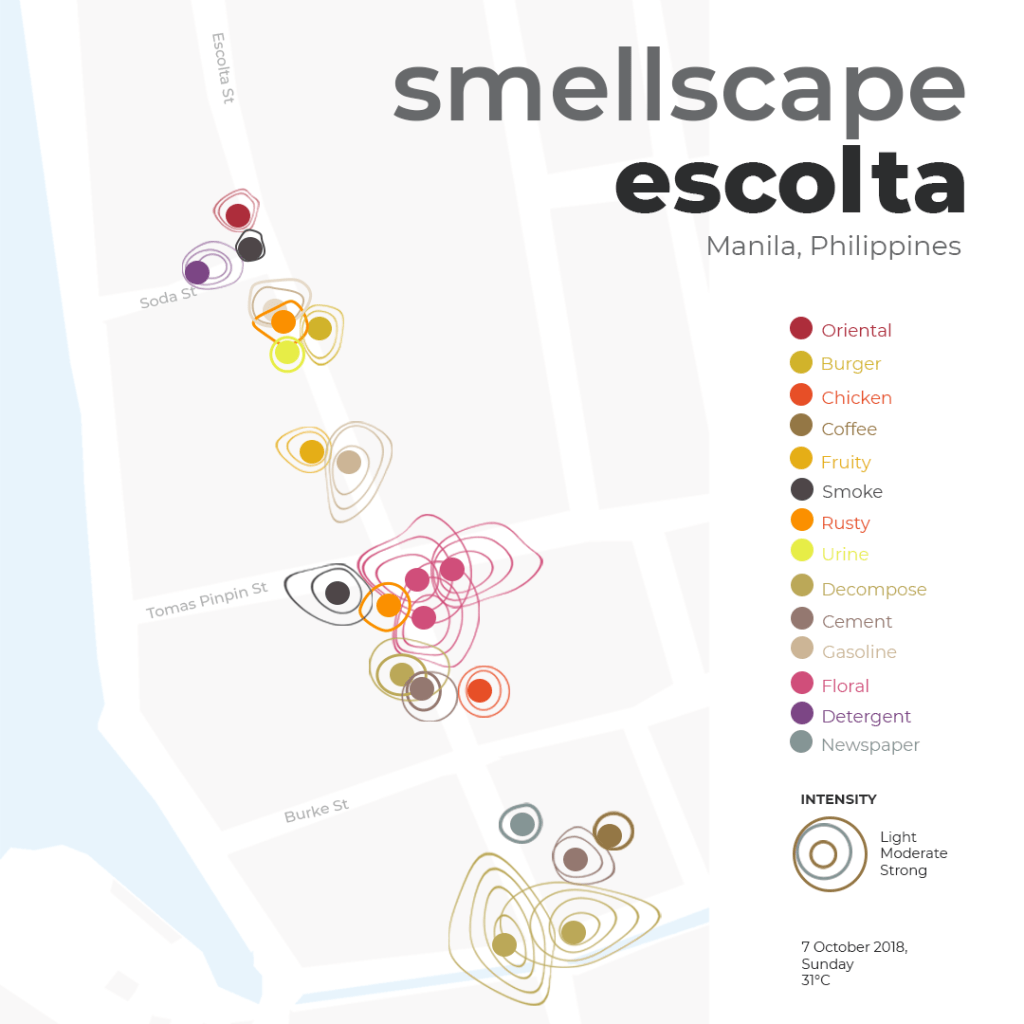
Scents and sensibility
What scents shape the city? How does scent contribute to placemaking? How do we design smell environments in the city? Victoria Henshaw, 2013 In Nikolai Gogol’s satirical short story The Nose (1836), Collegiate Assessor Kovalev’s nose went missing. “The nose can’t have removed itselfof sheer idiocy,” Kovalev thought. The nose turned out to have gained… Read more
 Geonarratives PH